After SMS-Activate closed in December 2025, finding a replacement became part of the job. Three months and 400+ activations later – this is what actually works.
Quick context on what this is about. For the past three years, testing registration and onboarding flows has been a significant chunk of my freelance QA work. Clients ship a new app or redesign their sign-up process, and someone needs to go through it 50 times from different geos, different devices, and different phone numbers to catch every edge case before real users do.
That “different phone numbers” part is where SMS activate services come in. Buying 50 SIM cards every time a client needs a registration audit is obviously not an option. Virtual numbers exist exactly for this – grab a temporary number, receive the OTP, verify the account, move on.
For two and a half years, SMS-Activate was the default tool for this. Cheap numbers, solid API, coverage in basically every country a client could ask about. Then in late December 2025, it shut down permanently. The site now shows a single page confirming the closure after ten years of operation.
So the search for the best SMS activate service started – not as a blog content exercise, but as an actual work necessity.
What “Best” Actually Means in This Context
Before getting into specifics, it helps to define what matters when SMS activations are part of a professional workflow rather than a one-off thing.
Reliability over price. A $0.005 number that fails wastes more money than a $0.10 number that works, because the wasted time is worth more than the nickel saved. When a client is paying for 8 hours of QA testing and 90 minutes get burned troubleshooting dead numbers, the savings evaporate fast.
Speed of delivery. Codes need to arrive within 30-60 seconds. Anything longer breaks the rhythm of batch testing. Waiting three minutes per activation across a 40-account test run means two extra hours of billable time.
Country coverage. A service that only covers 30 countries is fine for someone who only needs US numbers. For QA work that involves testing geo-locked sign-up flows in Brazil, Indonesia, Germany, and Japan in the same week, broad coverage is non-negotiable.
API quality. Manual clicking through a web UI works for five activations. For 50, an API is essential. And ideally, an API that does not require rewriting every integration from scratch when switching providers.
Payment flexibility. HeroSMS accepts cryptocurrencies, bank cards, bank transfer, E-Wallet, and Mobile Money — covering virtually every funding preference. Crypto remains available for users who prioritize anonymity, while card payments suit those who want a simpler top-up experience
With those priorities set, here is how the search went.
January 2026: The Messy Part
The first two weeks after the shutdown were chaotic. Every Telegram channel and subreddit had a different recommendation, most of them clearly paid placements. Tried four services in rapid succession.
OnlineSIM (onlinesim.io) was the first one. It has been around since 2013, which seemed like a good stability indicator. The platform offers both one-time activations from $0.01 and longer rentals. Got a few European numbers working quickly, but the country list was noticeably shorter than what SMS-Activate offered – around 90 countries versus 180+. Ran into stock issues with Indian and Indonesian numbers twice during a single afternoon. OnlineSIM is decent for straightforward European and US activations, but the narrower geo coverage became a recurring problem for multi-region testing.
5SIM (5sim.net) came next, mostly because it kept showing up as the cheapest option everywhere. And it is genuinely cheap – prices starting around $0.008. The statistics page that shows real-time success rates per country and operator is a useful feature that most competitors lack. But over three days of testing, the actual success rate for the specific combinations needed (Southeast Asian numbers for e-commerce apps, Indian numbers for WhatsApp) hovered around 60-65%. Fine for casual use, frustrating for professional workflows where every failed number means re-doing the step.
Grizzly SMS (grizzlysms.com) has competitive pricing from $0.04 and a clean modern interface. The experience was better than expected – decent delivery speed, responsive support via live chat. The catalog claims 260+ countries, though actual number availability was sometimes thinner than advertised. Worked well for a small batch of European activations but did not become a daily driver because number stock for less common geos was inconsistent.
SMS-Man (sms-man.com) boasts the biggest catalog on paper – 1,500+ services across 195 countries. That breadth is real and genuinely useful for niche platforms that other services do not cover at all. The issue was recycled numbers. Out of about 25 activations tested, four numbers were rejected by the target platforms because they had already been used for that service. The price per activation starts around $0.05, which is fair. But when 15-20% of numbers are burned before you even start, the effective cost per successful activation is higher than it looks.
None of these were terrible. All of them worked sometimes. The problem was “sometimes” – in a professional context, inconsistency is the most expensive thing.
How HeroSMS Entered the Picture
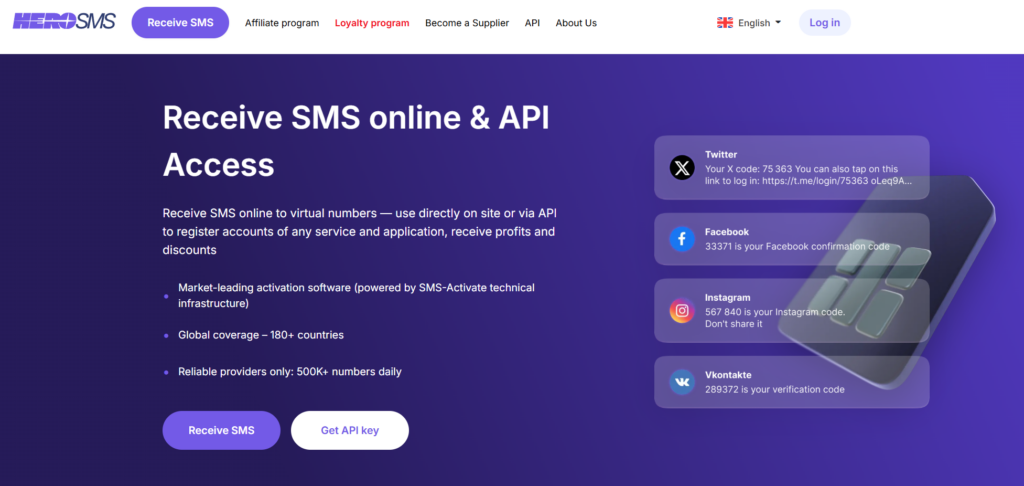
The answer was sitting on the SMS-Activate shutdown page the whole time. In their Q&A section, SMS-Activate included a question: “Where to buy numbers then?” Their response specifically named HeroSMS, explaining that they had provided their technologies to the HeroSMS team and recommending users try it.
This was not a third-party endorsement. The team behind the service that had been the industry standard for a decade was pointing to a specific successor.
Went to hero-sms.com with cautious expectations and set up an account.
Three Months With HeroSMS: The Honest Assessment
It has now been roughly three months since switching. Over 400 activations across dozens of services and countries. Here is what the experience has actually been like.
The Setup
Registration takes about two minutes. Top-up options are broad — Bitcoin, Ethereum, USDT and other cryptocurrencies, plus bank cards, bank transfer, and E-Wallet. The minimum deposit is small enough that testing with $5-10 first is easy.
The dashboard will feel immediately familiar to anyone who used SMS-Activate. Select a service from the left panel (there are 700+ pre-configured ones, plus an “Any Other” catch-all), choose a country, and the available numbers with their prices appear. Click buy, and the number shows up on the activation page. Paste it into whatever registration form, wait for the code to appear in the dashboard.
That is basically it. No learning curve if the previous workflow was SMS-Activate. The logic, the layout, even the API endpoint structure are built on the same foundation.
Pricing – Where It Actually Lands
The advertised “from $0.01” pricing is real but only applies to the cheapest service/country combinations. Here is what the most commonly used services actually cost based on three months of regular use:
- Google/Gmail verification: $0.02.
- Facebook: $0.02.
- Instagram + Threads: $0.015.
- WhatsApp: $0.15.
- Telegram: $0.13.
- Amazon: $0.03.
- Ticketmaster: $0.08.
These are not the lowest prices on the market. 5SIM and Grizzly SMS both have cheaper options for some of these. But factoring in the success rate – which has been around 97-98% over 400+ activations – the cost per successful activation is actually lower than platforms that charge less per number but fail more often.
The loyalty program helps over time too. HeroSMS uses a five-tier discount system based on total top-up amount, going up to 40% off at the highest level. It is not the kind of thing that matters on day one, but after a couple of months of steady use, the accumulated top-ups start pushing costs down.
Reliability – The Part That Actually Matters
This is the main reason HeroSMS became the daily driver. Here are the raw numbers from the tracking spreadsheet:
- Total activations (Jan-Mar 2026): 412.
- Successful deliveries: 403.
- Failed (no SMS within 20 min): 9.
- Success rate: 97.8%.
- Average delivery time: approximately 20-25 seconds.
- Fastest observed: 6 seconds (Google, US number).
- Slowest successful: about 3 minutes (WhatsApp, Brazilian number).
The nine failures were all automatically refunded – if the code does not arrive within the 20-minute activation window, funds return to the balance without opening a support ticket.
For context, the combined success rate across the other four services tested in January was roughly 70-75% for the same types of tasks. That 20+ percentage point difference is what makes the real impact on a workday.
The API
The API at hero-sms.com/api follows the same structure as the old SMS-Activate API. For anyone who had scripts or automation tools built for SMS-Activate, porting them over is minimal work – mostly changing the base URL and API key.
Standard flow: request a number for a specific service and country, receive the activation ID and phone number, poll for the SMS, get the code, mark as complete. Straightforward REST endpoints, no unusual authentication schemes.
One automation script that had been running against SMS-Activate for over a year was migrated in about 25 minutes. The biggest change was updating the endpoint URL and swapping in the new API key. The request/response structure was close enough that the parsing logic needed zero changes.
Country and Service Coverage
180+ countries is the claim, and it has held up in practice. Over three months, numbers have been successfully used from: US, UK, Germany, France, India, Indonesia, Brazil, Thailand, Turkey, Japan, Philippines, South Korea, Mexico, Canada, Netherlands, Spain, Italy, Australia, and about a dozen others.
The 700+ pre-configured services list covers all the obvious ones (every major social platform, email providers, messaging apps, e-commerce sites) plus a good selection of regional platforms. For anything not on the list, the “Any Other” option works as a catch-all.
500,000+ new numbers are reportedly added daily, which tracks with the observation that stock issues have been extremely rare. There were maybe two or three occasions where a specific country/service combination showed zero availability, and in each case, numbers appeared within an hour.
What Is Missing
No platform is perfect, and HeroSMS has clear gaps:
No number rentals. Every activation is one-time use within a 20-minute window. For the QA testing use case, this is fine – numbers are disposable by nature. But for anyone who needs to maintain ongoing access to a number (long-term 2FA, keeping a secondary account alive), there is no rental option. Platforms like OnlineSIM or TextVerified (textverified.com) cover that use case better.
No analytics dashboard. Spending and usage tracking is basic. There is no built-in way to see activation success rates over time, spending per service, or exportable reports. Everything gets tracked in a personal spreadsheet, which is fine but feels like a missing feature for professional users.
Interface is functional, not polished. It gets the job done without any friction, but there are no modern UI touches – no dark mode, no customizable favorites, no bulk-purchase workflow. It is the classic “built by engineers for engineers” experience.
The Bottom Line
After three months of daily use, a few hundred dollars spent, and over 400 activations across dozens of countries – HeroSMS has earned the spot as the primary SMS activate service in the toolkit. And the wide range of payment options — from crypto to bank cards — means there’s a top-up method for virtually every user.
It is not the cheapest. 5SIM and Grizzly SMS charge less per number for popular services. It is not the flashiest. The UI is utilitarian.
But for anyone whose work depends on virtual numbers actually working – consistently, quickly, across a wide range of countries and services – the reliability gap between HeroSMS and the alternatives tested was significant enough to justify the slightly higher per-number cost.
The fact that it is built on SMS-Activate’s own technical foundation is not just marketing copy. It shows in the API compatibility, the delivery infrastructure, and the number quality. When the team behind a decade-old industry standard says “use this instead,” and the experience backs that up, the recommendation carries weight.
For anyone still searching for the best SMS activate service after the shutdown – start with HeroSMS, test it with a small deposit, and compare it against whatever else is in the rotation. That is the most honest advice available, because the only real benchmark is whether the numbers work for the specific services and countries in a given workflow.
This write-up reflects personal experience from January through March 2026. Prices and availability change frequently in this market. Always verify current rates directly on hero-sms.com before committing budget.